Showing posts with label wool. Show all posts

Friday, January 15, 2021

Plaid Pinafore

Like so many seamstresses, I was very impressed by the styling and fashion choices in The Queen's Gambit and I've decided that I need more 60s vibe feminine clothes in my wardrobe. Not that I have many places to dress up for - today's dress up, apart from the photo session, was for the weekly shopping in the local Lidl :))) But if I worked in an office, I would definitely wear that pinafore dress to work.

The pattern is from Shkatulka, a sleeveless dress pattern in Russian, which comes free for my size 42 (the smallest available). The dress features semi-full skirt, princess seams and wrap top. The pattern includes facing pieces for the lapels and the collar, but once I cut the fabric, I realized that my wool plaid was too coarse and itchy, so I drafted additional lining pieces for the top and the skirt and made the pinafore fully lined.

Size: 42, shortened in height by 1 cm (top) and 7 cm (skirt)
Fabric: plaid, 100% wool; black cotton voile, 100% cotton (for the lining)
Thread: polyester, black and brown
Time to make: one week

The dress closes with a 30 cm side zipper. Because of the lined wrap top, I was very hezitant to install an invisible zipper - there was no possibility to insert the zipper between the outer and the lining, as they were sewn together because of the wrap. So I opted for an exposed zipper - I think it's OK, though I'm a big fan of invisible zippers.

I had only 1.2 m of this wool plaid, which I bought decades ago and I had to squeeze a semi-full skirt and a wrap top with lapels and facings, so some compromises had to be made with the pattern matching and especially the symmetry at the back. But I knew that from the very start and I made a deal with my perfectionist self to deal with it and not think about it twice. I managed to match the horizontal lines of all those princess seams, so that should be good enough :))

I am especially proud of the lapels - my first ever! The Shkatulka instructions were very sketchy and I was not quite sure I liked the proposed order of constructing the top, so I googled Youtube. I highly recommend Diane Deziel's tutorial - as always she's the best and made the daunting lapels fairly easy to make!

Another problem I had to deal with was the construction of the lining - the facing of the lapels was only partially equal to the outer front lapels, so to avoid constructing the facing of the fronts out of partial front lapel plus the side front part, I drew a new side panel, which incorporated both parts and I think it worked! I'm still curious how was I supposed to add the side zipper, given that in order to add the skirt to the top I had to fix the wrap, as a result of which the lining and the outer of the top became inseparable. I'd be curious to know how this is done in the industry, I'm sure there are some professional tricks, but I couldn't find a Youtube tutorial, though I searched extensively.

All in all, I'm quite pleased with my 60s style plaid pinafore. If I ever decide to repeat the pattern, I'll have to figure out how to make it a bit more fitted at the bust, but otherwise the fit is acceptable and I was happy to walk the aisles of Lidl today dressed prettily :)


Thursday, November 28, 2019

Tweed Hoodie


This year I started following one of Russia's knitting gurus - Olga Kondratyeva, who opened my eyes to a number of knitting designs and trends. One of her popular videos is on how to make a classic knitted hoodie - a sweater with raglan long sleeves, a large hood and a front kangaroo pocket.


Back in February, when I decided to knit another of Kondratyeva's designs - a tweed dress, I ordered 400 g of Italian tweed wool mix, but the dress only took 200 g. I had been looking at the bobbin and wondering what to do with it for several months until I finally decided to turn it into a hoodie. In the process I found that the 200 g would not be enough if I wanted the hood as large as I planned it to be (though I'm short I have a long neck and standard hoods usually come short on me, go figure!), so I ordered another 100 g of the tweed yarn (plus a couple of other bobbins :))))  The yarn is Natural Fantasy Condor 4, a wooly tweed with very complex composition - 62% wool, 6 % angora, 10% silk, 4% modal, 18% polyamide.


Pattern: Tweed Hoodie (personal pattern based on Olga Kondratyeva's video tutorials)
Yarn: Natural Fantasy Condor 4, 260 g
Needle: 3 mm (ribbing), 3.25 mm (stockinette stitch)
Time to knit: one month


The hoodie is very warm and comfortable - I wore it yesterday to my Spanish classes and though it was fairly cold in the room I was feeling almost toasting in it. The yarn in the bobbin was fairly uneven and quite coarse but after wet blocking it softened.


I finished the pocket edges, the hood edges and the ribbing with 3-stitch I-cord and I also added some ribbing to the sides of the body for better fitting and to enhance the sports vibe of the sweater. Now, that I'm looking at the pictures and considering the bagging of the elbows, I'm thinking of adding some leather patches to the elbows too. Might be cool if I can pull it off.


And a final note - although I knitted the hoodie for myself, I'm posing in the pictures and I've worn it a couple of times, I decided to gift it to Gaby - I think it is more in her style and she might get better wear out of it.

Tuesday, December 25, 2018

Broken Violet

One of my favourite youtube channels for yarn dyeing is ChemKnits Tutorials  - I've learned so much from Rebecca Brown! Rebecca's signature yarn is Wilton's broken violet - evidently the compound Wilton's food dyes brake during the dyeing process, as some of the dyes, like the reds, bind quicker to the yarn than the yellows and the blues. The violet dye brakes very spectacularly from deep violet to bright light turquoise blue.

We don't have Wilton's food dyes here and from my experience chemical acid dyes don't brake, but I wanted to try the experiment with some egg dyes. Last Easter I bought a couple of packets of egg dyes, however only one of them contained violet, the others had only the three primary colors and green. Anyway, I brought a pot of water with the citric acid to boil and added to it the violet capsule and one red and one blue dye tablets. I wound a 50 g ball of superwash wool sock yarn into a skein, twisted it and presoaked it. The plan was to let the twisted skein absorb first the reds and then untwist it while still in the water and let the undyed part of the yarn take the blue. Well, our dyes are obviously different from Wilton's, so it didn't quite work like that and the dye looks more as a gradient rather than broken.


However, I liked the result and as I wanted to keep it as it was, I didn't let the yarn exhaust all of the the dye and took the skein out of the pot. While the skein was dripping I noticed that the drip water was blue. So I decided that the braking was possible, I just had more reds in the pot than blues.


I quickly grabbed a second ball of sock yarn and this time I wound it into consecutive double  thread 10 g skeins, a total of six connected skeins. As I thought I had mostly blue in the water, I added another red dye tablet and began gradually adding the miniskeins:


The braking of the dye didn't work as I imagined, the dye was even redder and what I obtained was a gradient again. I like it, however, and it is my current sock project. And again, I didn't exhaust the dye and again the dripping water was bluish.


I wound a third ball of sock yarn and, without adding any more dye tablets into the water and even without presoaking it (which wasn't probably such a good idea) I began gradually dipping it into the water. This time I did get to the blue:


The red in the pot was very little and it bound to the first half of the skein, while the rest of the skein turned blue. This time I let the skein exhaust the dye. However, this is my least favourite skein of the three, I don't particularly like the shade of blue on it and I am considering glazing it with black with some resist knots for richer coloring.


Monday, October 29, 2018

The Chocolate Color

Let me start with the ascertainment that ever since I started dyeing yarn, I've overdyed every beige yarn I've bought, as well as a beige cotton shop bought sweater I had :) Beige turns out to be a color I'm drawn to buy but not to wear - neutral drab colors are not for me, it seems.

A few months ago I came upon Hipster - a shawl pattern by Joji Locatelli and I immediately fell in love with it. I've been following Joji's podcast and admiring her creativity a lot, she's one of my main inspirations to start sewing again, as apart from a talented knitter and designer, she's also a fearless beginner seamstress.
So, when I was browsing my favourite online yarn shop for tweed for another project I came upon a sale of this beige Italian bobbin tweed and I grabbed 200 g of it for Hipster. But the moment it arrived I knew I had to overdye it (again!). I experimented with at least a dozen of small cuttings from the yarn, shifting it from tobacco yellow to dark purple, until I settled on chocolate. And I'm loving it. This is my current WIP, but more about it and the yarn in (I hope) a coming soon posting :)


And while I still had chocolate color on my mind I finally decided how to overdye the viscose yarn I had bought for my mother. The result of another sale purchase - 6 skeins of baby blue viscose-acrylic yarn, three for me and three for my mother, were waiting to be overdyed. The yarn is very soft, the color is nice, but neither mother nor I would wear this baby blue. I had been struggling for a week with the decision, having in mind, that unlike the wool, which is so easy to dye, viscose acrylic blends take dye differently and more difficultly. And of course they require dyes for cellulose based yarns. 

To ensure good cover of the blue, I dyed these skeins in two steps - first I dyed the three skeins solid brown, washed them and hung them to dry to ascertain that they had the color I wanted (wet viscose looks much much darker than dry viscose and I wanted to be sure). Then I dip glazed them in concentrated black for a more variegated final color.

I think they turned out quite nice, with deep saturated color. Because I dyed each skein separately, there are some variations between the skeins and as with all hand-dyed yarns it would be recommendable to be knitted with alternation.

I was curious, so I made two samples to check the gauge. The yarn is thin - 400 m / 100 g, so it could be knitted with a single thread or with two threads held together. I was leaning towards the thicker option, but in the end I like the single thread sample better. Of course, it's up to my mother to decide which she prefers.

Now I'm off to pack all the yarns I dyed for my mom lately and send them to her to keep her busy during the coming months.

Sunday, October 21, 2018

Autumn Colors

As the Indian summer is over and it's cold and gloomy and rainy outside, I am taking out my wool dyes and getting my knitting mojo back.This weekend I got to play with two new to me Bulgarian sock yarns. Until now I've only used the Turkish Alize Superwash 75% wool 25% nylon, 420 m / 100 g and I am quite pleased with it. But I'm always curious for something new.


The Performance yarns have the same technical description as Alize Superwash, but so far I'm happier with them than with the Turkish yarn, as far as dyeing goes. The yarn took the dye beautifully, preserving its shine and smoothness better that Alize Superwash. Of course, the major test - knitting, is still ahead, I'll be counting on my mother for reviews, as these skeins are a present from me for her.

I used one and the same method for both skeins - layering of colors on twisted hanks, using four colors for each hank, three of which were the same and done simultaneously - butter yellow, bright yellow and orange. For the fourth color I chose green for the first skein,

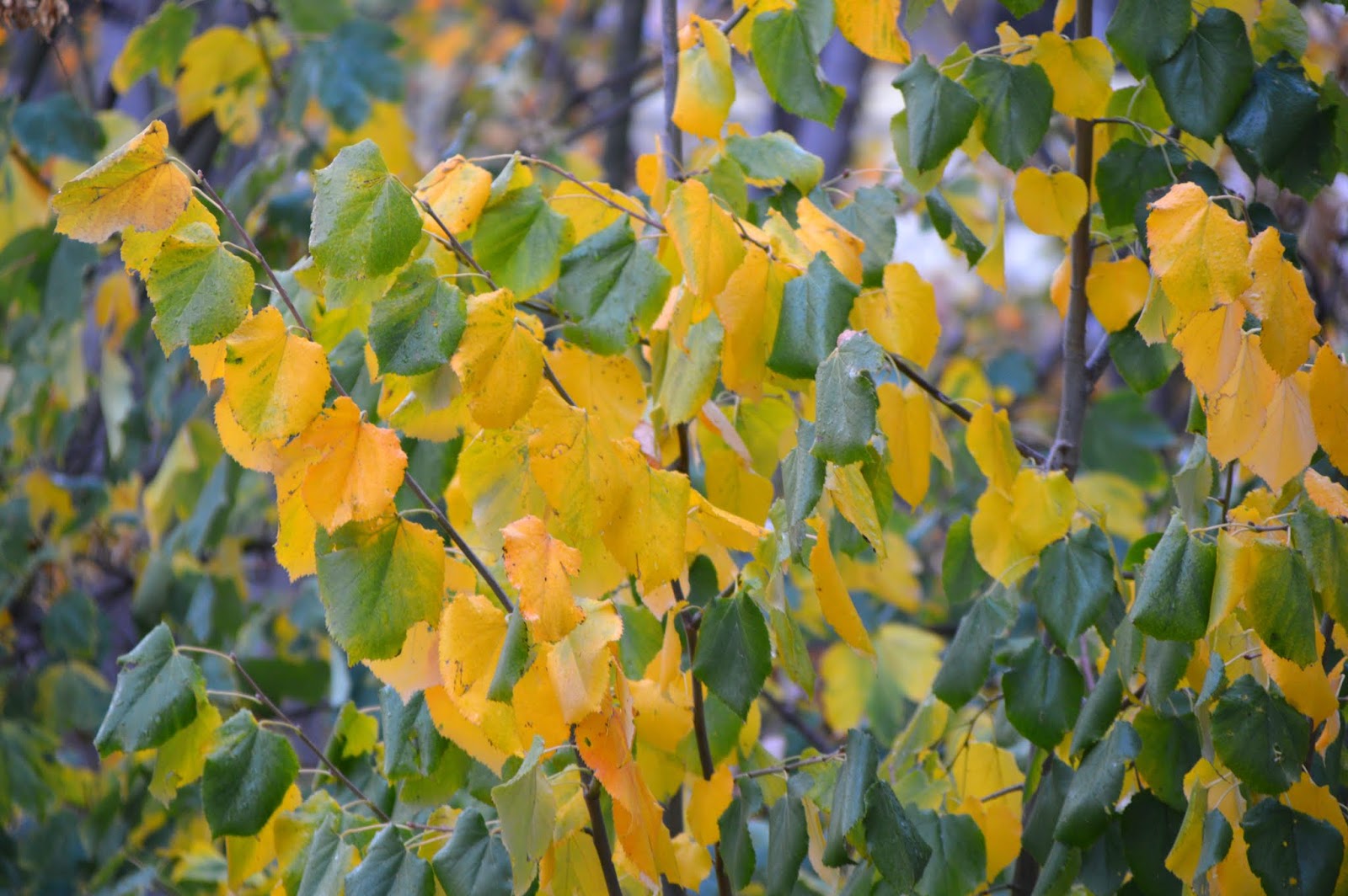
trying to imitate this tree in front of our building.

And for the second hank the fourth color was sort of chocolate brown - a mixture I made myself from yellow, red, blue and black. On these pictures the skeins are still a bit messed from the dyeing


and here they are reskeined, smoothed and ready to be sent. I love reskeined yarn, as it gives better idea of the distribution of the colors and how they would knit up in the future socks.

Tuesday, June 12, 2018

Murder, She Wrote


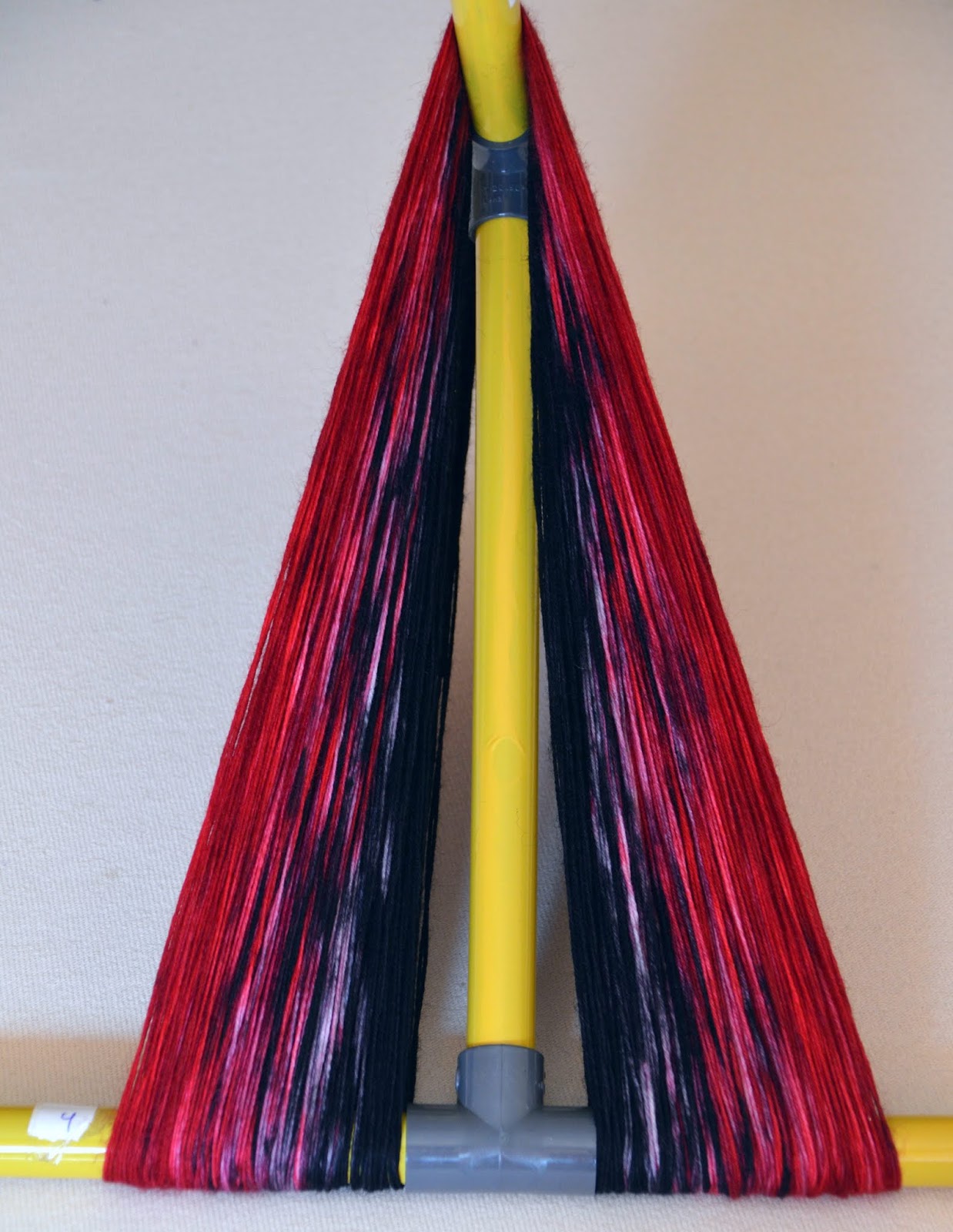
This is a dyeing experiment I've been planning to try for a long time, as it produces very interesting two-color results. And because my two colors are blood red and black, the end result strongly suggests too much reading and watching of crime mysteries :)


The process - the yarn is loosely wound into a ball, not a cake and is submerged into the first color. The dye penetrates unevenly from the outside to the inside of the ball. After the first color is exhausted, the ball is taken out of the dye bath and let to dry a bit. I intentionally collapsed part of my ball, as the dye wasn't penetrating into the ball and I didn't want to be left with a couple of red layers and all white yarn.


After some significant time of struggle with the mess the collapsed ball had created I rewound the yarn, starting from the outer red layer and exposing the white yarn to the outside of the ball.


Then I dropped the ball into the black dye bath. I used the same water, as it already had the citric acid in it, I only added the black dye to the bath.This time I did not collapse the ball, as I didn't want to turn everything black. I like the light greyish - pink transition section, but for fuller coverage one could dye the entire skein red and then cover only part of it with black.

As I wanted to be certain that the dye was well fixed to the yarn, I steamed the yarn for 20 min, placing it in a strainer above the dyeing pot, filled with clear water.

As the yarn is intended for socks for my husband, I had initially double stranded it, so the final step was to divide it back into two one strand cakes - a very time consuming effort, as the yarn was like a 300 m string of twisted threads. I'm not quite sure why this happens, but dyeing two identical cakes with a two-stranded skein always ends into such a twisted string and it is a big nuisance and very unfriendly to the yarn. If my yarn wasn't superwash, it would probably have ended somewhat felted.
Now on to knitting these murderous socks :)


Thursday, November 23, 2017

New Sock Yarn and WIP


And my latest yarn dyeing results - a set of two colorways for a pair of socks. The grey for the toes and the heels was dyed in the microwave. I placed the yarn in clear water with citric acid and then poured the dye here and there on the yarn to create slight variations of color.


The yarn for the body of the socks was kettle dyed, using the twisted skein technique. First I applied the light grey color, washed the yarn, retwisted the skein and applied the light pink color and after washing again the yarn and retwisting it yet again I added the third color - light lilac.


The combination is a bit outside of my comfort zone, as I am definitely a red-yellow-orange person, but I intend to gift the socks to a friend and I think these might be more her colors.


And a sneak-peek to my WIP - a sweater for Gaby I cast way back in February. It's half brioche, it's thin yarn, it's black - and it's taking forever! I knit the back for almost a month and abandoned it for more interesting projects. Recently I resumed my work on it, but now and again I feel the urge to diversify with something smaller and more colorful for some instant gratification. I do hope the sweater will turn wearable in the end, as being short and boxy it is quite far from my preferred forms, but we'll cross our fingers and hope for the best.


Saturday, July 1, 2017

Wheaten


It's +40C outside, but I've finished a wool shawl :) It's Wheaten from Wool People Vol. 5 collection - lovely and easy lace shawl, which I made in my currently favourite bobbin wool yarn - Zegna Barrufa Cashwool.


Pattern: Wheaten by Anne Hanson
Yarn: Zegna Baruffa Cashwoo, 200 g, 640 m
Needle: 4 mm border, 4.5 mm body
Time to knit: almost a month


I took my time with this shawl - a month is quite a long time for me, but it's hot and not exactly the shawl knitting weather here. However I have plenty of cotton cardigans and blouses and I don't feel like knitting cotton this summer. These Italian bobbin wools are so soft and pleasant to knit, that I've already bought two more sweater-size quantities from the same on-line shop - one is the same Cashwool in orange-red and the other is a mixture of cashmere, merino and silk in juicy red-pink colors. Seems I'm rediscovering wool this summer :)


If I had more of this yarn, I would have probably made my Wheaten bigger, to be used both as a winter accessory and as a summer shawl over dresses. As it is - 153 cm long and 33 cm wide, it is less of a summer wrap, but with our extra hot summer this year who needs wraps anyway!