Showing posts with label прежда. Show all posts

Friday, December 23, 2022

Christmas Yarn

A couple of sock yarn skeins I dyed for my mother. She is a fan of my sock yarn and regularly asks me for new skeins to knit. This time I chose two different methods of dyeing - striped yarn and low immersion. 

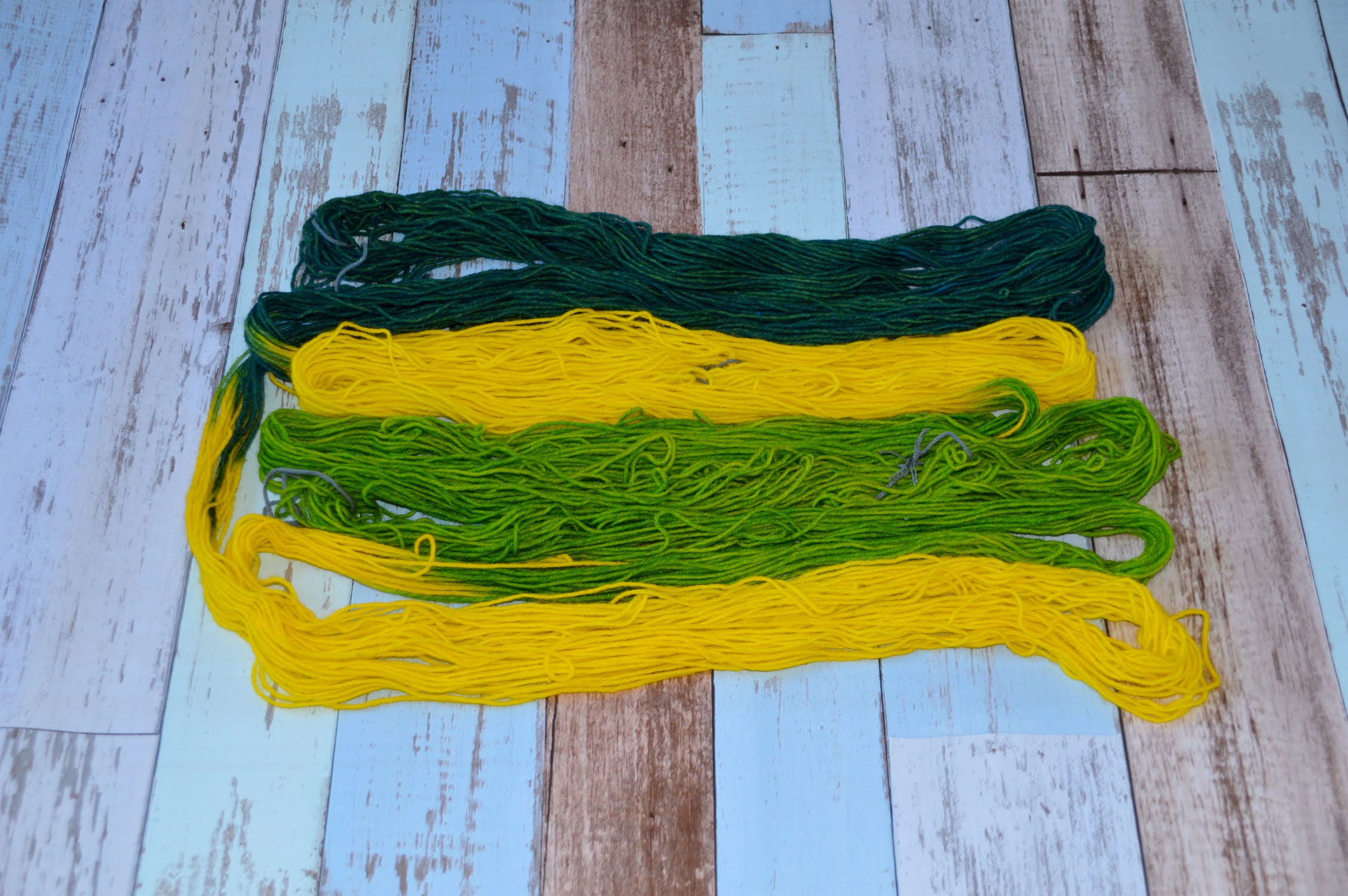
For the striped yarn, I wound the skein into a long loop and soaked it into warm water with citric acid. Then I brought the water in my dye pot to boil and added the yellow color. My plan was to divide the loop into 4 parts - one long blue, followed by a short yellow, then a long green and again a short yellow, the yellow dividers half as short as the blue and green stripes. However, once I had finished dyeing the yarn, had it washed and almost dry, I did not like it. The colors were rather primary and the end result somewhat reminded me of the Brazilian flag. Not that there is anything wrong with it and its colors, it was just not what I had had in mind.
So, after some inner struggle, I took out the dye pot again, prepared another dosage of yellow dye and dipped the blue and the green parts of the yarn in yellow. Naturally, they both turned into green, two different shades. Then I dipped the former blue part of the yarn into additional blue to darken it and make it more pine green. I was finally satisfied and now it is my favourite yarn, can't wait to see it knitted into socks!
For the second skein I chose low immersion. This skein is very much like the skein I made for my husbands Nalu socks, variations of different reds, orange, wine red, some brown and pink and even an instant soft drink powder for good measure. This is a combination of shades I never tire to dye and knit and I do hope my mother would appreciate it.
One of the risks of low immersion, especially in a crowded pot, is that some of the yarn might be left white, if the dye has failed to reach it. It did happen this time as well, so I had to redo the dyeing process with this skein too, applying scarlet red to the undyed white blotches.
I'm sure these will knit into another pair of beautiful socks too. Now, that I have sent my gift yarn away, my hands itch me for dyeing some sock yarn for myself as well :)

Wednesday, December 8, 2021

Berry Punch Yarn

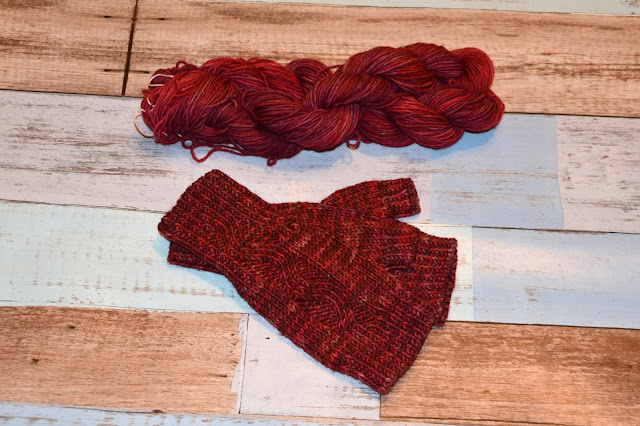
About 10 years ago I did my first yarn dyeing! And probably because of beginner's luck, but it was one of my most successful dye jobs. The yarn was pure merino, I used three saches of instant drinks (a local analogue of Cool Aid) and I knitted a pair of fingerless gloves with it, which are still very much in use and still my most favourite late autumn - early spring gloves.

Husband and I were talking about these gloves on our hike on Vitosha recently and it occurred to me that I had never tried to recreate that dye job. I had some white Yarnart Superwash sock yarn at hand and I thought a pair of socks, matching the gloves was actually a very good idea.

I found my blog posting, read the instructions and went out in search for STEP instant drinks. As we never buy such products, I hadn't followed the market. Unfortunately (for me), it turned out that in the 10 year interval the Red Grapes variety had been discontinued. However, I found another drink by the same manufacturer, which contained two of the three E artificial colours of Red grape - the red and the blue, but it lacked the chocolate brown.

I prepared the yarn and the drinks according to my own instructions and dyed the yarn. Then washed it and let it dry. The resulting skein (shown on the last picture) was a bit redder and paler than the mitts, so I made a light solution of bordeaux and brown acid dyes and dipped the whole skein in it. I am much happier with the overdyed skein (shown on the first picture), but I'll wait until tomorrow and natural light to decide if I want to leave it as it is or deepen further the brown and bordeau shades.


Wednesday, May 20, 2020

Sock Yarn for My Mother

I hadn't played with wool dyes for quite a while and I hadn't realized that I actually missed it.
My mother loves knitting socks and when I was preparing my parcel with the Rhapsody blouse, I decided to add two skeins of sock yarn, dyed by me. For both skeins I used low immersion techniques and I wound the yarn into very long skeins, using the "walk between two chairs" method :) The yarn is Alize Superwash, 75% wool, 25% polyamide.

I dyed the first skein in the pot, adding a range of warm colors - yellow, orange, red, pink, scarlet and brown. I tried to distribute them randomly, hoping that there will be minimal pooling when knit into socks.


I am very happy with the final warm combination of colors and can't wait to see what will become of these.

For the second skein I used again low immersion, but in a tray - yellow and green in both ends and variations of chartreuse between. And i also added orange speckles to this skein. I love the color combination, but I worry that the color distribution will definitely result in pooling.


Inspired by these skeins, I made another one for myself, but more about it next time :)

Tuesday, December 25, 2018

Broken Violet

One of my favourite youtube channels for yarn dyeing is ChemKnits Tutorials  - I've learned so much from Rebecca Brown! Rebecca's signature yarn is Wilton's broken violet - evidently the compound Wilton's food dyes brake during the dyeing process, as some of the dyes, like the reds, bind quicker to the yarn than the yellows and the blues. The violet dye brakes very spectacularly from deep violet to bright light turquoise blue.

We don't have Wilton's food dyes here and from my experience chemical acid dyes don't brake, but I wanted to try the experiment with some egg dyes. Last Easter I bought a couple of packets of egg dyes, however only one of them contained violet, the others had only the three primary colors and green. Anyway, I brought a pot of water with the citric acid to boil and added to it the violet capsule and one red and one blue dye tablets. I wound a 50 g ball of superwash wool sock yarn into a skein, twisted it and presoaked it. The plan was to let the twisted skein absorb first the reds and then untwist it while still in the water and let the undyed part of the yarn take the blue. Well, our dyes are obviously different from Wilton's, so it didn't quite work like that and the dye looks more as a gradient rather than broken.


However, I liked the result and as I wanted to keep it as it was, I didn't let the yarn exhaust all of the the dye and took the skein out of the pot. While the skein was dripping I noticed that the drip water was blue. So I decided that the braking was possible, I just had more reds in the pot than blues.


I quickly grabbed a second ball of sock yarn and this time I wound it into consecutive double  thread 10 g skeins, a total of six connected skeins. As I thought I had mostly blue in the water, I added another red dye tablet and began gradually adding the miniskeins:


The braking of the dye didn't work as I imagined, the dye was even redder and what I obtained was a gradient again. I like it, however, and it is my current sock project. And again, I didn't exhaust the dye and again the dripping water was bluish.


I wound a third ball of sock yarn and, without adding any more dye tablets into the water and even without presoaking it (which wasn't probably such a good idea) I began gradually dipping it into the water. This time I did get to the blue:


The red in the pot was very little and it bound to the first half of the skein, while the rest of the skein turned blue. This time I let the skein exhaust the dye. However, this is my least favourite skein of the three, I don't particularly like the shade of blue on it and I am considering glazing it with black with some resist knots for richer coloring.


Tuesday, June 12, 2018

Murder, She Wrote


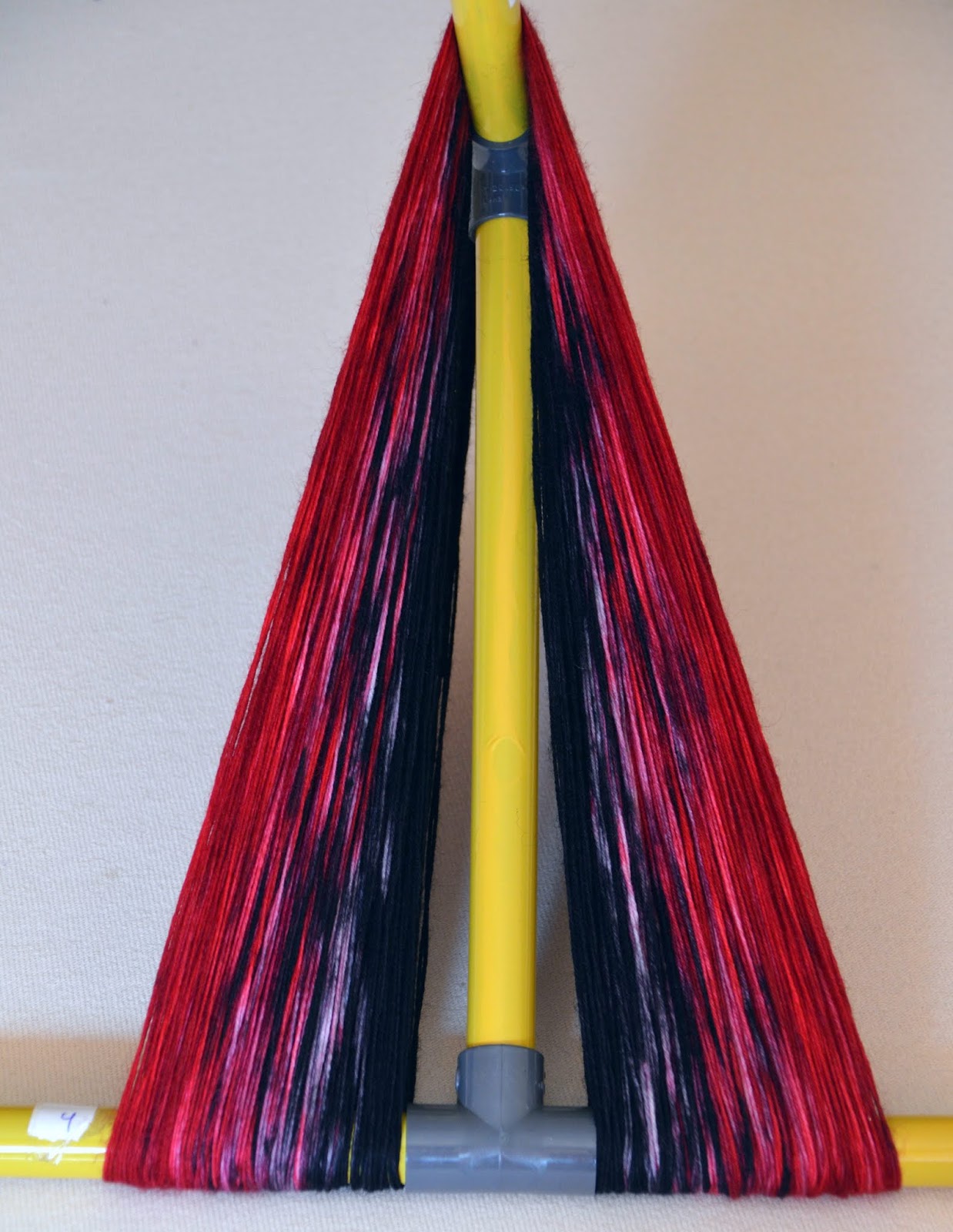
This is a dyeing experiment I've been planning to try for a long time, as it produces very interesting two-color results. And because my two colors are blood red and black, the end result strongly suggests too much reading and watching of crime mysteries :)


The process - the yarn is loosely wound into a ball, not a cake and is submerged into the first color. The dye penetrates unevenly from the outside to the inside of the ball. After the first color is exhausted, the ball is taken out of the dye bath and let to dry a bit. I intentionally collapsed part of my ball, as the dye wasn't penetrating into the ball and I didn't want to be left with a couple of red layers and all white yarn.


After some significant time of struggle with the mess the collapsed ball had created I rewound the yarn, starting from the outer red layer and exposing the white yarn to the outside of the ball.


Then I dropped the ball into the black dye bath. I used the same water, as it already had the citric acid in it, I only added the black dye to the bath.This time I did not collapse the ball, as I didn't want to turn everything black. I like the light greyish - pink transition section, but for fuller coverage one could dye the entire skein red and then cover only part of it with black.

As I wanted to be certain that the dye was well fixed to the yarn, I steamed the yarn for 20 min, placing it in a strainer above the dyeing pot, filled with clear water.

As the yarn is intended for socks for my husband, I had initially double stranded it, so the final step was to divide it back into two one strand cakes - a very time consuming effort, as the yarn was like a 300 m string of twisted threads. I'm not quite sure why this happens, but dyeing two identical cakes with a two-stranded skein always ends into such a twisted string and it is a big nuisance and very unfriendly to the yarn. If my yarn wasn't superwash, it would probably have ended somewhat felted.
Now on to knitting these murderous socks :)


Friday, March 23, 2018

Marbled Pastels


I got an idea in my head to knit another Haruni for a present - my third Haruni, I really love this triangular shawl. And I imagined it in light pastel colors, combined around turquoise. I googled color combinations and I really liked this marble, so I tried to recreate it.


The yarn is Italian bobbin merino extrafine, which I have used before. It is super soft, 4-ply not very twisted yarn - a characteristic, which makes it divine to wear, but it has also a tendency to pill.


I was very happy with the yarn in the pot, but as it dried and I began to knit with it, I've been having my doubts. The yarn was a bit crowded in my small dyeing pot - 200 g is a bit too much for it, and the colors came very light with lots of white in between.

It looks colorful in the skein

but the knitted texture is very colorless, the purples and pinks are almost indiscernible. And these are so not my colors :( I love warm colors, I'm a red - brick - orange person, these cold pastels are too babyish for my taste. So far I'm planning to knit the shawl and if i hate it - I'll redye it into a solid darker color, probably dark teal or turquoise.


Monday, January 8, 2018

Rust and Teal

Yesterday and today I spent hours experimenting with yarn dyeing. The color scheme was rust and teal and the technique - self-made sock blanks.


For the first blank I folded the strands into two and then again into four stranded cake. My new cake-winder was definitely very useful. Then I knitted the yarn into a simple garter stitch blank.


The color scheme I chose was teal and rust.
For the teal I mixed green and blue 1:1. This is where I faulted and should have been braver to correct it - my teal turned more green than blue and I should have dipped the green end into a little blue to accentuate the teal color, but I didn't, being afraid not to ruin it.
The rust was 8 orange + 2 red + 1 brown and it turned as I wanted it.


This is how the blank looked still wet after the dyeing - dip dyed on the stove:

I unraveled it and wound it on my niddy-noddy to dry. This was the dry yarn in the morning, four-stranded:

The yarn, separated into two-stranded yarn:

And finally separated into singles:

And wound into cakes ready to be knit with:

I wound the second ball of Alize Superwash into 8-stranded yarn and knit it into a garter stitch wider and shorter blank to be dyed in stripes. This is the color scheme I chose for the stripes:


In the evening, the process of dyeing. This time I hand painted the stripes and then nuked it into the microwave for 1:30 + 2 + 1 min.

The yarn cool and ready to be washed:

Dry and finally separated back into singles:
And the cakes.

Final thoughts: very labour consuming method, rather intense on the yarn. The dyeing of blanks produces interesting speckled effects because of the knitted texture of the blanks. However I am not likely to try it again soon, I believe I've satisfied my curiosity as far as this method of dyeing is concerned.

Sunday, November 12, 2017

Biker Chick Imitation Yarn


For my new yarn dyeing I chose the colorway of one of my favourite yarns - Miss Babs Biker Chick. The yarn is far beyond my yarn budget and I've only seen it on photos, but I love the contrast between the warm orange and the cold grey and black.


The dye technique I used is fairly new to me and proving to be my favourite - literally painting the yarn drop by drop, eyeing the end result, retouching and overlaying colors until I get it as I want it. For this yarn I used two yellows, one red and one orange dye for the warm colors and a grey and black dye for the dark colors.


Then I wrapped the yarn in a foil and microwaved it for a total of 6 minutes. The results are quite satisfactory - the dye didn't leak to the neighboring sections and the whites stayed white, the dye bled almost none when I washed it afterwards and this process is much more tender to the yarn as it gets almost no manipulation compared to kettle dyeing. This is definitely my technique of choice for multicolor colorways.


And I reskeined the yarn to show how the colors would mix during knitting.


It looks so great in the ball, I should buy a cake winding machine, even if only to show off my hand dyed yarn :)