Showing posts with label боядисване. Show all posts

Saturday, November 15, 2025

Red Socks

Three years ago I dyed two different colorways of sock yarn for my mother as part of my Christmas present for her. Unfortunately, as she is getting old, she is already 80, knitting is difficult for her and she never knitted the yarn I gifted her. 

I really can't stay idle, so during my visit in early autumn I took out one of the yarns and started knitting a sock. I finished the sock during my next visit and took the remaining yarn and needles with me, to finish the pair in Sofia.

The pattern I used is my usual most simple recipe. I cast 11 stitches on each needle for a toe-up sock, using Judy's magic cast-on. Then I gradually increased to 58 sts, forming the toe of the sock and then I continued knitting in the round, until I reached the heel of the sock.

For the heel I used the Fish Lips Kiss Heel method, which produces a nice round heel. I finished the socks with a long 1x1 rib and Lora's stretchy cast-off. As my yarn was divided into two equal parts before it was hand-dyed, it was easy to make the second sock exactly the same as the first.

Pattern: Red socks (personal pattern)
Yarn: Alize Superwash, hand-dyed, 50 g
Needle: 2.5 mm circular
Time to knit: a couple of days with big intervals in-between

I finished the socks some days ago, but kept postponing the photosession. And as it turned out - for good reason. Yesterdays hike to Pchelina provided us with the perfect background for these colorful socks. I intend to give them back to my mother next time I visit and probably knit the second pair of sock yarn I had gifted her three years ago.


Friday, December 23, 2022

Christmas Yarn

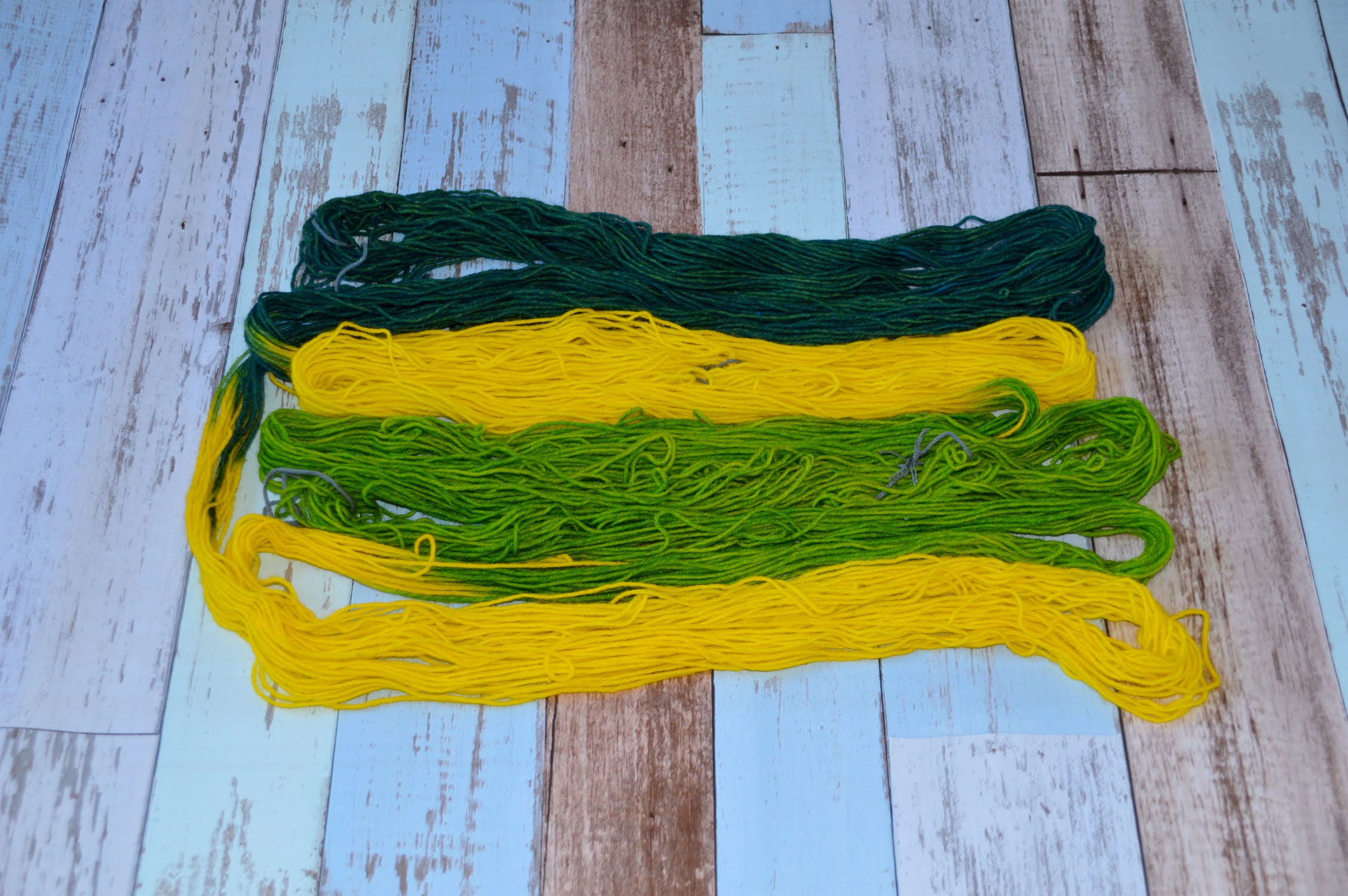
A couple of sock yarn skeins I dyed for my mother. She is a fan of my sock yarn and regularly asks me for new skeins to knit. This time I chose two different methods of dyeing - striped yarn and low immersion. 

For the striped yarn, I wound the skein into a long loop and soaked it into warm water with citric acid. Then I brought the water in my dye pot to boil and added the yellow color. My plan was to divide the loop into 4 parts - one long blue, followed by a short yellow, then a long green and again a short yellow, the yellow dividers half as short as the blue and green stripes. However, once I had finished dyeing the yarn, had it washed and almost dry, I did not like it. The colors were rather primary and the end result somewhat reminded me of the Brazilian flag. Not that there is anything wrong with it and its colors, it was just not what I had had in mind.
So, after some inner struggle, I took out the dye pot again, prepared another dosage of yellow dye and dipped the blue and the green parts of the yarn in yellow. Naturally, they both turned into green, two different shades. Then I dipped the former blue part of the yarn into additional blue to darken it and make it more pine green. I was finally satisfied and now it is my favourite yarn, can't wait to see it knitted into socks!
For the second skein I chose low immersion. This skein is very much like the skein I made for my husbands Nalu socks, variations of different reds, orange, wine red, some brown and pink and even an instant soft drink powder for good measure. This is a combination of shades I never tire to dye and knit and I do hope my mother would appreciate it.
One of the risks of low immersion, especially in a crowded pot, is that some of the yarn might be left white, if the dye has failed to reach it. It did happen this time as well, so I had to redo the dyeing process with this skein too, applying scarlet red to the undyed white blotches.
I'm sure these will knit into another pair of beautiful socks too. Now, that I have sent my gift yarn away, my hands itch me for dyeing some sock yarn for myself as well :)

Wednesday, December 8, 2021

Berry Punch Yarn

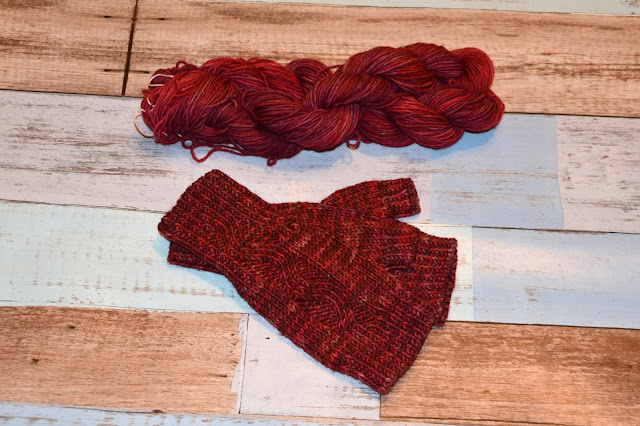
About 10 years ago I did my first yarn dyeing! And probably because of beginner's luck, but it was one of my most successful dye jobs. The yarn was pure merino, I used three saches of instant drinks (a local analogue of Cool Aid) and I knitted a pair of fingerless gloves with it, which are still very much in use and still my most favourite late autumn - early spring gloves.

Husband and I were talking about these gloves on our hike on Vitosha recently and it occurred to me that I had never tried to recreate that dye job. I had some white Yarnart Superwash sock yarn at hand and I thought a pair of socks, matching the gloves was actually a very good idea.

I found my blog posting, read the instructions and went out in search for STEP instant drinks. As we never buy such products, I hadn't followed the market. Unfortunately (for me), it turned out that in the 10 year interval the Red Grapes variety had been discontinued. However, I found another drink by the same manufacturer, which contained two of the three E artificial colours of Red grape - the red and the blue, but it lacked the chocolate brown.

I prepared the yarn and the drinks according to my own instructions and dyed the yarn. Then washed it and let it dry. The resulting skein (shown on the last picture) was a bit redder and paler than the mitts, so I made a light solution of bordeaux and brown acid dyes and dipped the whole skein in it. I am much happier with the overdyed skein (shown on the first picture), but I'll wait until tomorrow and natural light to decide if I want to leave it as it is or deepen further the brown and bordeau shades.


Sunday, June 28, 2020

Yellow socks


I knitted another pair of socks, with hand-dyed yarn, naturally :)
We took pictures of the socks yesterday, during our hike on Rila. I almost forgot about the photosession and the socks would have stayed tucked away in my backpack, which would have been a shame. Luckily, there were many lakes along our way and we had a very long hike, so almost any time it occurred to me to take pictures, there was a postcard scenery awaiting to be taken advantage of :)


I had 10 g sock-yarn remnants from another pair of hand-dyed socks. As I loved the yarn, I wanted to use it up and pair it with a matching hand-dyed yarn. I decided to play with the yellow in the tropical yarn, so I dyed a ball of white sock yarn in three shades of yellow-orange, using the low immersion twisted skein method. What this means - I prepared a dye bath first with a lemonade shade of yellow, twisted the presoaked skein and dipped it in the dye bath until the dye was exhausted. Then I took out the skein, untwisted it, let it cool and twisted it again. Dipped it in orange-yellow and let it soak the dye. And then again repeated the process with the last shade of color - orange. To make sure that the dye was well fixed, I then heated up again the dyed skein in the microwave for a total of 2+2 minutes.


As both of these yarns - the tropical 10 g and the white 35 g, were remnants from other socks, the resulting socks are short, with small cuffs, but I think the combination works really well and the socks were worth making. I used my favourite recipe for toe-up socks, 58 stitches, FLKH, Lory's twisted bind off.


Pattern: Yellow socks (personal pattern)
Yarn: Alize Superwash, hand-dyed, 45 g
Needle: 2.5 mm
Time to knit: 5 days


Friday, May 22, 2020

Golden Lichen Socks

I just finished a new pair of socks and these are my new most favourite! Still enthused by the dye job I did for my mother's socks, I decided to mix the greens, oranges, yellows and browns into a new pair of socks for myself.


My inspiration were the golden lichen on the oak trees we noticed during our hike to Pchelina lake at the beginning of the month.

For these socks I used the direct painting method - it is the most slow of all, but provides the best control over the painting process. I spread the skein of yarn, soaked in water with citric acid, on a sheet of stretch foil and gradually painted it all in various hues of earth colors.

Then I wrapped the foil and fixed the dye in the microwave oven.

I'm absolutely loving the result - so warm and balanced, these are definitely my colors!


I divided the skein in two and knitted the socks, following my usual recipe - toe up, Judy's magic cast on, 58 sts, stockinette stitch, fish lips kiss heel, 1x1 rib, Lori's twisty bind off.


Pattern: Golden Lichen (personal pattern), 58 stitches
Yarn: Alize Superwash 52 g, hand dyed
Needle: 2.5 mm
Time to knit: 10 days


Although these are almost the same colors as in these socks, the different method of distribution of the colors results in a distinctly more balanced and pleasing texture, without color pooling.


Wednesday, May 20, 2020

Sock Yarn for My Mother

I hadn't played with wool dyes for quite a while and I hadn't realized that I actually missed it.
My mother loves knitting socks and when I was preparing my parcel with the Rhapsody blouse, I decided to add two skeins of sock yarn, dyed by me. For both skeins I used low immersion techniques and I wound the yarn into very long skeins, using the "walk between two chairs" method :) The yarn is Alize Superwash, 75% wool, 25% polyamide.

I dyed the first skein in the pot, adding a range of warm colors - yellow, orange, red, pink, scarlet and brown. I tried to distribute them randomly, hoping that there will be minimal pooling when knit into socks.


I am very happy with the final warm combination of colors and can't wait to see what will become of these.

For the second skein I used again low immersion, but in a tray - yellow and green in both ends and variations of chartreuse between. And i also added orange speckles to this skein. I love the color combination, but I worry that the color distribution will definitely result in pooling.


Inspired by these skeins, I made another one for myself, but more about it next time :)

Friday, May 1, 2020

Burda 6840 Blouse


 Right before I bought the Rhapsody blouse, I attempted to recreate the style with another pattern I have in my collection - Burda 6840. It is a shirt pattern, but I easily turned it into a blouse by omitting the cut of the front and the buttons, widening a little bit the neckline and adding a split at the front. I made the split in the manner of the sleeve splits for cuffs. My fabric is cotton lawn, which was snow white and I dyed it this brick orange color with cotton dyes (a mix of red, yellow and black).
I cut the smallest size - 36 and made my usual modifications for petite height, and as the blouse was also rather wide and my fabric was not drapy, I reduced the width by a total of 8 cm, thus bringing the pattern from 36 (s) to 32 (xxs). I think it fits Gaby's slender figure just right.

 The ties can be worn loose or tied to close the neckline.

 Gaby does not like oversized and long blouses, so this one hits her just above the hips.


I made my seams french seams with the exception of the armscye seams and I burritoed the back yoke.

Based on these modifications, I made a size xs (34) paper pattern for myself, but I'm not sure if I'll make it. It is very similar in style to the Rhapsody blouse and I prefer its cut as more flattering.
Nevertheless I quite like my modified Burda 6840 and I hope it will get some wear.


Tuesday, December 25, 2018

Broken Violet

One of my favourite youtube channels for yarn dyeing is ChemKnits Tutorials  - I've learned so much from Rebecca Brown! Rebecca's signature yarn is Wilton's broken violet - evidently the compound Wilton's food dyes brake during the dyeing process, as some of the dyes, like the reds, bind quicker to the yarn than the yellows and the blues. The violet dye brakes very spectacularly from deep violet to bright light turquoise blue.

We don't have Wilton's food dyes here and from my experience chemical acid dyes don't brake, but I wanted to try the experiment with some egg dyes. Last Easter I bought a couple of packets of egg dyes, however only one of them contained violet, the others had only the three primary colors and green. Anyway, I brought a pot of water with the citric acid to boil and added to it the violet capsule and one red and one blue dye tablets. I wound a 50 g ball of superwash wool sock yarn into a skein, twisted it and presoaked it. The plan was to let the twisted skein absorb first the reds and then untwist it while still in the water and let the undyed part of the yarn take the blue. Well, our dyes are obviously different from Wilton's, so it didn't quite work like that and the dye looks more as a gradient rather than broken.


However, I liked the result and as I wanted to keep it as it was, I didn't let the yarn exhaust all of the the dye and took the skein out of the pot. While the skein was dripping I noticed that the drip water was blue. So I decided that the braking was possible, I just had more reds in the pot than blues.


I quickly grabbed a second ball of sock yarn and this time I wound it into consecutive double  thread 10 g skeins, a total of six connected skeins. As I thought I had mostly blue in the water, I added another red dye tablet and began gradually adding the miniskeins:


The braking of the dye didn't work as I imagined, the dye was even redder and what I obtained was a gradient again. I like it, however, and it is my current sock project. And again, I didn't exhaust the dye and again the dripping water was bluish.


I wound a third ball of sock yarn and, without adding any more dye tablets into the water and even without presoaking it (which wasn't probably such a good idea) I began gradually dipping it into the water. This time I did get to the blue:


The red in the pot was very little and it bound to the first half of the skein, while the rest of the skein turned blue. This time I let the skein exhaust the dye. However, this is my least favourite skein of the three, I don't particularly like the shade of blue on it and I am considering glazing it with black with some resist knots for richer coloring.